

I’ve been quiet here on Substack for a while but a lot has been happening behind the scenes – and I’m excited to share.
During that time, Context Institute’s core team has been developing and testing what feels like a major breakthrough in our 40+ years of working on deep cultural change.
Our approach to accelerating cultural transformation starts with recognizing that, to address the needs and opportunities of these times, we need to work at the deep level of the culture’s operating system: the constellation of often implicit assumptions, beliefs, and behaviors that shape the culture’s thinking, being, and doing.
The culture’s institutions and specific patterns and behaviors are then like apps built on this operating system (OS). They can only be improved within the limits of the culturalOS.
Our modernist culture’s operating system is based on the 18th-century Age of Enlightenment (AoE), which has taught us to:
view the world in fragmented, mechanistic ways
see language, categorical thinking (rationalism), and reductionist empiricism as the legitimate forms of knowledge
focus on individual accomplishment, advancement, and fulfillment as the primary aims in life
These and related elements of the AoE culturalOS have had a profound influence on the world over the past few centuries. However, since World War II, modernist culture has created a world where the symptoms of its limitations – as exemplified in the polycrisis – have grown enormously.
While we appreciate the many efforts to deal directly with those symptoms, we have chosen to focus on the culturalOS level. In this time of great change, that is where we feel the real leverage resides.
We’ve developed a framework for where and how the culturalOS needs an upgrade, which we call the Foundational Keys.
Distilled from a wide range of experience, science, and scholarship, the Keys are a set of topic areas and perspectives that point to a culturalOS that is better suited to the 21st century. They retain the still-valuable parts of the AoE culturalOS (such as the value of empirical science) while supplying missing pieces and replacing overly simplistic assumptions (such as about “rationality” and “objectivity”). More than a critique, they are a map to an appealing, realistic, coherent culturalOS that can stand on its own.
At their heart are the essential capabilities of being:
Savvy about psychodynamics, especially your own
Skillful with diverse modes of perceiving and thinking (cognition)
Adept at win-win-win collaboration
(For more on the Keys, please see this Substack post.)
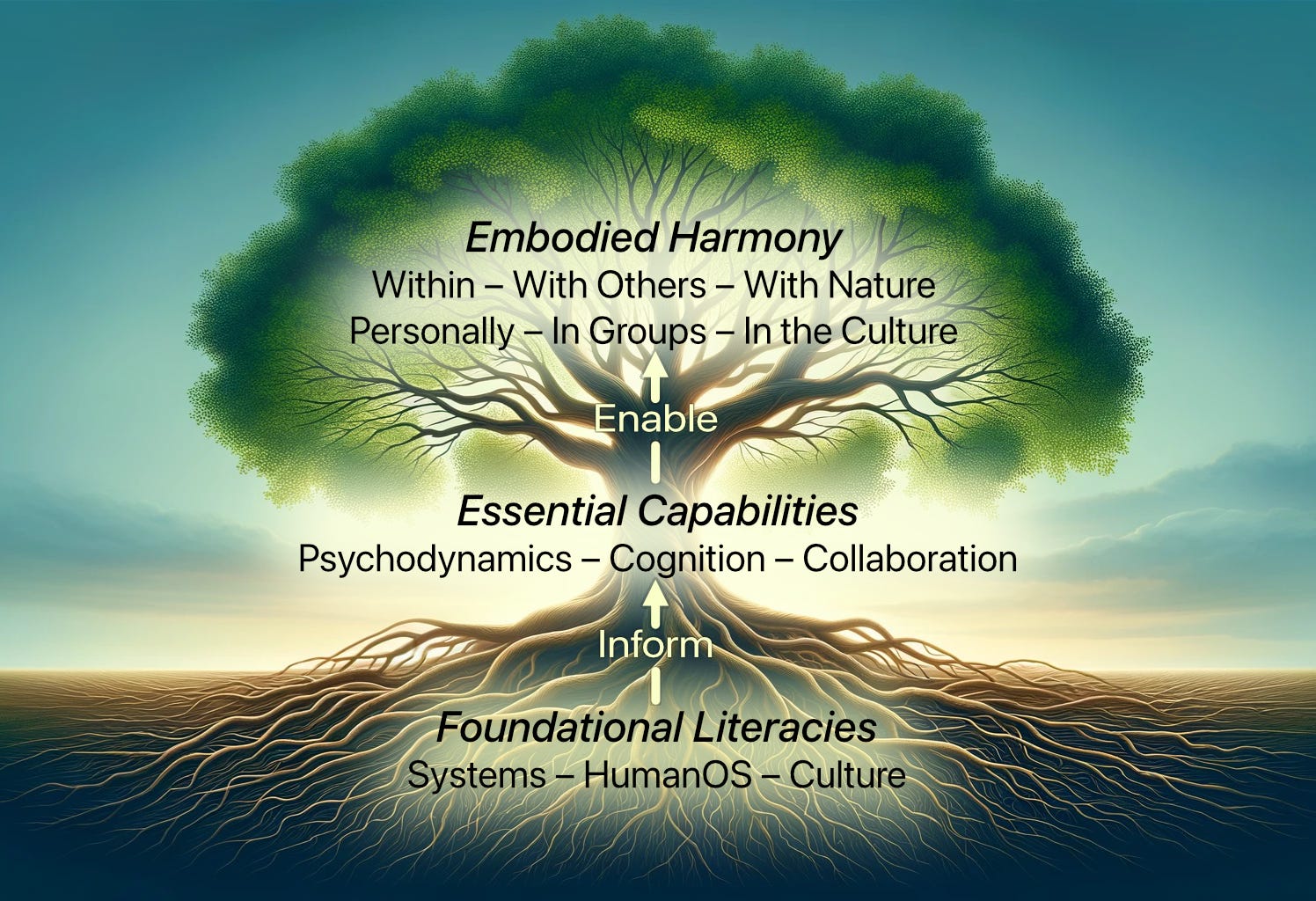
But how can you upgrade something as pervasive as a culturalOS?
We approach this with the help of the Foundational Keys and recognize that culture is a living system, a complex adaptive system. Its evolution can be influenced but not controlled or engineered. The changes need to be lived and evolved through experience.
We begin by showing that the upgrade can be done, by helping people acquire the Keys-based capacities they need to begin to live using the new OS.
We strengthen the upgrade by creating strategic cultural innovations based on the new OS that make old business-as-usual patterns obsolete.
The upgraded OS and its innovations then spread organically by example and the real benefits they convey.
We support that spread through educational programs, media, and networking.
We are guided by decades of social-science research on the diffusion of innovations, including the recent work of Damon Centola, for how to facilitate the spread of both individual innovations and the culturalOS upgrade.
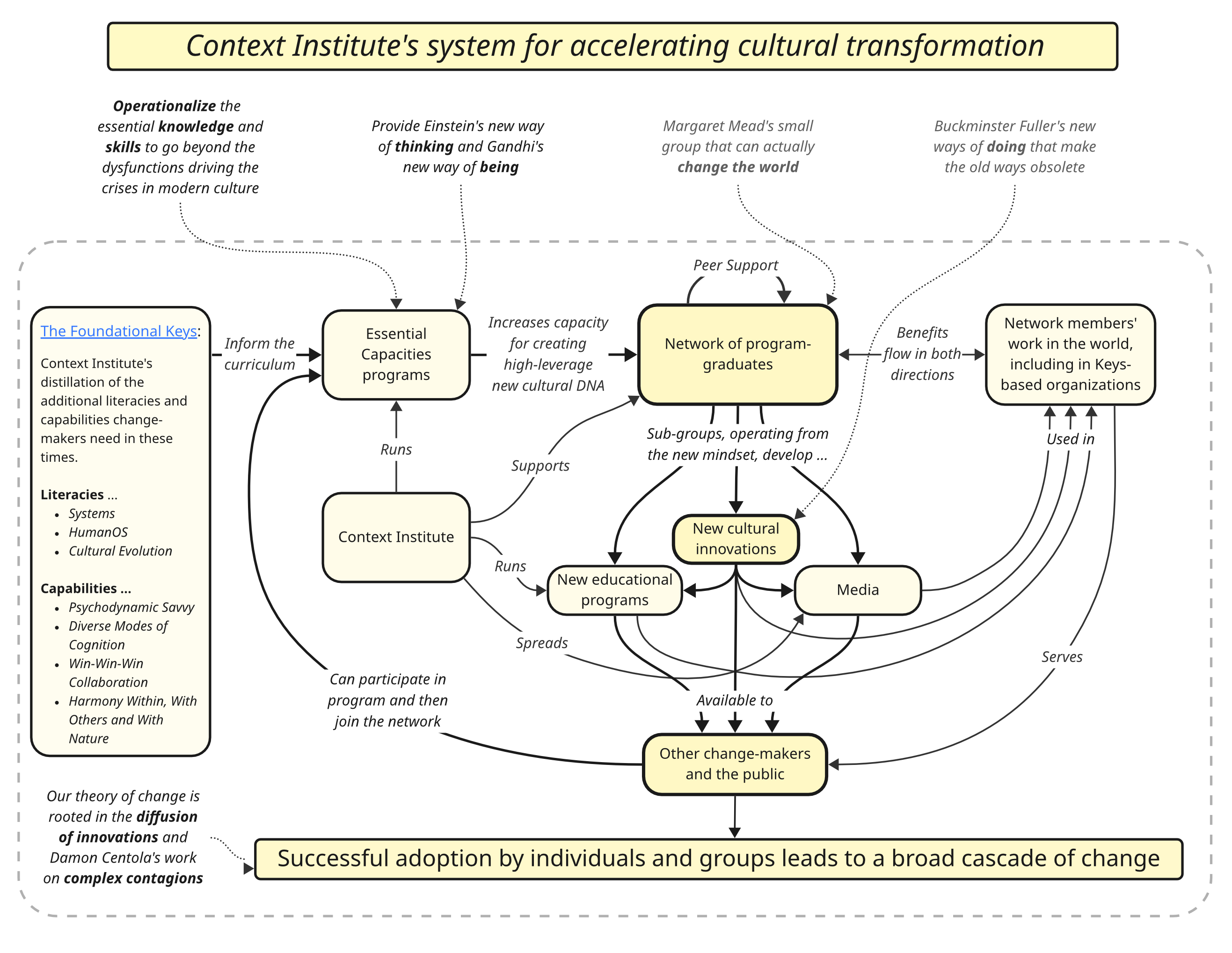
The approach we’re using is illustrated here:
(Click to enlarge the image.)
Start at the box that says “Essential Capacities programs”. These are experiential learning programs that enable participants to apply the Keys in practice in their lives and, in the process, begin to live the new culturalOS. I’ll describe these programs in detail in the Building Essential Capacities post.
The graduates from the new programs can then choose to become part of our network, which provides ongoing support for living the new culturalOS. Some of these graduates will develop:
new cultural innovations
new educational programs
new media material all based on the new culturalOS.
Most graduates will continue to do their professional work in the world. As they do so, they will bring their new orientation, help to develop the new cultural innovations, and share their learning back with the network.
The output from all of this activity then spreads out to the public.
What kind of cultural innovations are we envisioning? A good example is Optimal Zone Resilience.
It’s a set of life-skills that can be adopted personally or by groups.
It addresses modern culture’s lack of skill in collaborating with our autonomic nervous system (ANS). As a result, we wind up being blindly driven by our nervous system’s automatic reactions.
It conveys clear benefits: access to our better, more creative and resilient cognitive capacities and a more positive emotional life.
Its implications are pervasive and profound: Our autonomic nervous system shapes every moment of our lives, and most of the world’s current problems are made much more challenging by the widespread lack of these skills.
It rests directly on the HumanOS and Psychodynamics Keys: The past few decades have provided major advances in our understanding of the ANS and how to partner with it. The culture hasn’t caught up but, with the help of this innovative set of life-skills, we can catch up and then help others to do so as well.
This is just one example of the many strategically significant innovations that the Keys illuminate. There’s a lot of low-hanging fruit just waiting to be harvested!
Groups play an important role in the process, since culture needs to be shared. This starts with the network of program graduates and then radiates out to all the groups those graduates are part of.
We are particularly interested in providing guidance and support to organizations who want to transition to a group culture and structure based on the Keys. These will serve as living laboratories where the new culturalOS and its “apps” are further developed.
Context Institute has precursors in place for most of the parts of this cultural transformation system. These include Bright Future Now, which we offered from 2016 to 2024 as a live online training and is now available on this site as the BFNow Self-Study program, and the Bright Future Network, with over 360 Bright Future Now graduates from 34 countries.
Our work over the recent months has brought the overall system to a whole new level. I’ve been working for decades on how to enable deep, lasting cultural change, and it feels like the puzzle of how to do this finally has the pieces it needs.
I’m thrilled to be able to share this and to be part of bringing this living system into being.
The Building Essential Capacities post gives you more specifics on the benefits of the Essential Capacities programs and invites you into ways you can become part of bringing this new culturalOS into being.
This is so exciting, I'm so thrilled to be part of the Essential Capacities next cohort! :) ❤️